
If the Iran War Ended Today, Here's How Long It Would Take for Gas Prices to Fall

- A Pound of Ground Beef Now Costs More Than the Federal Minimum Wage
- 1.3 Million Taxpayers May Be Owed a Refund From 2022. Here's How to Claim It Before the Deadline
- Study Reveals How Much Money You Need to 'Thrive' in Today’s Economy
- Some Student Loan Borrowers Are Getting $2,000 'Surprise Checks' From an Old Navient Lawsuit
- How Buying a Home Before You Turn 30 Is a ‘Wealth Multiplier’
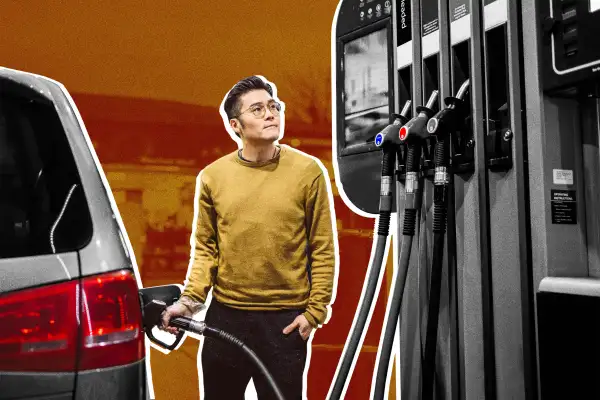
As the Iran war stretches into its second month, gas prices continue to rise for drivers in the U.S. with no end in sight.
On Thursday, the national average price for a gallon of regular, unleaded gas hit $4.08, according to AAA’s gas tracker. That marks an increases of nearly 40% from $2.93 in the days before the U.S. and Israel launched a bombing campaign on Iran that started Feb. 28.
Experts who spoke with Money say that Americans should expect high gas prices to linger even after the Iran war concludes. And when the war will end is a big, open question.

In an address to the nation on Wednesday, President Donald Trump gave an update on the war — and, to some extent, gas prices — but did not lay out a clear time frame for a cessation of hostilities.
“Many Americans have been concerned to see the recent rise in gasoline prices here at home,” Trump said. “This short-term increase has been entirely the result of the Iranian regime.”
Trump blamed Iran for sending oil prices into disarray because it closed the Strait of Hormuz, a critical international waterway for oil trade located along the country’s southern shore. He stated that the strait will re-open once the war is over.
“When this conflict is over, the strait will open up naturally. It will just open up naturally,” Trump said. “It will resume the flowing and the gas prices will rapidly come back down.”
When Russia invaded Ukraine in February 2022, gas prices surged and peaked above $5 a gallon later that year. But the spike was relatively short-lived, and prices fell back to pre-war levels by November 2022. However, experts don't expect gas prices to fall quickly this time around, even in the best-case scenarios.
“I don't think it's going to be that clear-cut,” says Patrick De Haan, head of petroleum analysis at GasBuddy. “Things could worsen before they get better.”
When will gas prices come back down?
The biggest factors driving up gas prices right now are the ongoing Iran war and the closure of the Strait of Hormuz. Although the U.S. produces most of the oil needed for gas domestically, oil is a global commodity, and major supply shocks affect its price.
For gas prices to come back down, those international issues must first be resolved.
On Wednesday, Trump said the U.S. was on track to complete all of its military objectives “very shortly,” although he suggested that the war could go on for at least “two to three weeks” as the U.S. plans to “hit [Iran] extremely hard.”
Even if the Iran war were to end today, experts say gas prices will remain elevated.
“It will take weeks, if not months, to re-open the Strait of Hormuz and for global oil production and prices to normalize,” Mark Zandi, chief economist at Moody’s Analytics, says in an email.
“There is also a lag between when oil prices decline and this results in lower gas prices,” he adds. “This goes to the old adage that gas prices go up like a rocket and fall like a feather.”
The type of fuel also makes a difference. Diesel and jet fuel, for example, have different supply chains and disruptions ripple through more slowly than gas. De Haan notes that the conflict will especially affect airlines — and the price of plane tickets — for months to come.
"I wouldn't say you're going to lose the summer travel season," he says, "but it's going to be a really, really rough one."
‘No going back to $3 a gallon’
It’s not just a question of when gas prices might fall, but by how much. Experts tell Money that drivers shouldn’t expect to see pre-war gas prices any time soon.
“I don't think that gasoline prices are going to return to their pre-war level because there's going to be a heightened geopolitical risk that's now priced into the oil market,” says Andrew Lipow, president of the energy consulting firm Lipow Oil.
Now that Iran has essentially shut down the Strait of Hormuz, Lipow says that will always be a tangible risk going forward. Basically, the cat is out of the bag.
Zandi and De Haan agree, saying that the potential for the strait shutting down in the future will make oil shipping more expensive, thus keeping gas prices elevated long-term.
“Even if the war ended today,” Zandi says, “there is no going back to $3 for a gallon of regular unleaded for the foreseeable future.”
Compare rates from Personal Loan lenders

Get Personalized, Pre-qualified Rates from Multiple Lenders
- 2-Minute Online Application Process
- Loans from $600 to $200,000
- Rates from 6.25% APR - 35.99% APR ¹
- Loan terms of 1 - 7 years
- Rated A+ by the BBB

Fast online application with quick approval decisions
- Competitive fixed rates and flexible loan terms¹
- No fees for application or prepayment
- Funds available as soon as the next business day²
- Simple, transparent pricing with no hidden costs

Loans from $10,000 - $100,000
- Must have good to excellent credit
- Flexible payment terms and no fees/prepayment penalties
- Same day funding if certain conditions are met
- Personal and debt consolidation loans, auto refinancing, and more
- Simple online application can be completed in minutes

Personal loans from $1,000 to $50,000
- Loan APR range: 7.74% - 35.99% ¹
- Fast Funding. Money is sent to your bank account within a day of clearing any verifications
- Transparent terms and absolutely no prepayment penalties
- Access to free credit monitoring, alerts, and features to help you understand your credit
- No obligation and no impact to your credit score when you check your rate
- Dedicated to serving since 2016

Get funded in as fast as 1 business day
- APR: 7.80% - 35.99%¹
- Borrow from $1,000 - $50,000
- Loan terms: 3 or 5 years
- Best for consumers with bad credit or no credit history
More from Money:
How to Save Money on Gas Right Now
Best Gas Station Credit Cards for 2026
Lawmakers Scramble to Suspend Gas Taxes