Want to Save Money on Gas? Do This, New Study Says

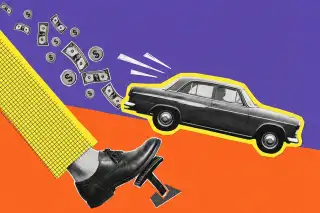
A new study finds that the secret to spending less on gas is in your hands — or, more accurately, under your right foot. Speeding burns more gas, which tanks your gas mileage. What’s more, you don’t even save that much time getting from Point A to Point B, a pair of researchers from the University of Minnesota Twin Cities determined.
With gas prices once again hitting $4 a gallon nationwide, it’s understandable that drivers are looking for clever hacks to avoid pain at the pump.
Must Read
Many of the previous studies about how speeding impacts your mileage were based on laboratory tests or relied on extrapolating from a small amount of real-world data.
But this new paper, which was published in the journal Communications Sustainability, goes the distance: Researchers analyzed a data set of over 120 million trips taken by American drivers in 2021 and found that sticking to the speed limit would save $22 million in gas costs every single day.
That's a savings of 6.7 million gallons of gas, which has the added benefit of reducing carbon dioxide emissions by 57,000 metric tons. Even speeding slightly can erode your mileage, which costs money in extra fuel costs.
While some vehicles get better mileage than others, a good rule of thumb is that the optimum driving speed for fuel economy is between 40 and 55 mph. At highway speeds, going even 10 mph above the speed limit can burn roughly 20% more gas.
And sorry, EV drivers — you’re not off the hook, either: The researchers found that speeding burned through the available energy in a car’s battery quicker, which translates to more electricity consumption.
Discounts Galore with an AARP Membership
Frequent speeders wasted the most fuel
Researchers looked at three key speeding metrics: How often drivers speed, how fast they go and how much of a particular trip is spent speeding. On average, they found that drivers spend roughly 13% to 14% of a trip driving 10 to 11 mph over the posted limit.
Across two different speeding scenarios, the paper found that drivers who didn't speed burned between 2.4% and 3% less gas. For EVs, the difference was even more dramatic; drivers saw an average of 9% energy savings when they slowed down.
The driving behavior that had the biggest impact was the prevalence of speeding: In other words, drivers who habitually treat their morning commute like a Formula 1 course would get the most financial benefit out of changing their behavior.
And if you think you need to speed because you’re running late, think again: Researchers found that speeding shaved a mere 54 seconds off the average trip time. As it turns out, speeding doesn't really save you all that much time, despite the perception.
Other research has also found that driving defensively more broadly saves gas. An earlier paper from researchers at the Massachusetts Institute of Technology found that drivers who didn’t drive aggressively — that is, they didn’t speed and avoided both quick accelerations and hard braking — could shave 6% off their fuel consumption.