Warren Buffett Has a Warning for Investors as Stocks Hit Record Highs

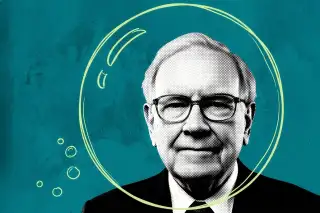
Warren Buffett has seen a market bubble or two. And if the Oracle of Omaha is right about what makes bubbles so dangerous, investors may want to pay attention to today's stock market.
Whether we are experiencing a bubble today is up for debate — especially among market observers from Wall Street to Silicon Valley. Equities have been on a tear, with the major indices hitting new record highs on a regular basis, even as traders fret about the durability of the AI-fueled spending boom that’s fueling demand for — and driving up the price of — everything from electricity to electronics.
Must Read
"There's a lot of speculation in the stock market that looks quite a bit like the previous tech bubble in the late 1990s," David Rosenberg, founder of Rosenberg Research, told Money last fall. Since then, stocks have continued to post robust gains.
One commonly used metric, the S&P 500's Cyclically Adjusted Price-to-Earnings (CAPE) ratio, currently sits at 41.79, well above double the long-term historical median of 16.11 and very close to the record 44.19 it hit in November 1999, shortly before the dot-com crash.
This ratio compares stock prices with average inflation-adjusted earnings over the previous 10 years. It is used as a rough aggregate of market sentiment; the higher the number, the more traders are willing to bank on healthy returns in the future. The higher a company’s share price climbs relative to its profit, the greater traders’ confidence that the company will deliver future returns that justify its elevated stock price.
Another ratio, commonly called the Buffett Indicator after the investing legend characterized it as a bellwether economic barometer in 2001, is the aggregate value of all U.S. stocks divided by gross domestic product (GDP). This figure is also extremely elevated by historic standards. Economists sounded the alarm when this data point climbed above 200% at the end of 2024; since then, it has risen to nearly 240%, reflecting a degree of optimism about growth from Wall Street that might not be borne out in terms of real economic activity on Main Street.
Must Read
Buffett on bubbles, through the years
In Berkshire Hathaway's annual letters to shareholders and at the yearly shareholder meetings in Omaha, Nebraska, that came to be referred to as "Woodstock for capitalists," Buffett held forth on both the danger and the inevitability of bubbles.
His insights over the course of his six decades at the helm of Berkshire remain valuable for investors today, because while companies expand and technology progresses, the human nature that is the common driving force in all bubbles remains the same.
The dot-com crash
As a conglomerate, Berkshire is the corporate parent of companies that sell everything from candy to car insurance. These companies entered the internet era with varying degrees of success, giving Buffett a front-row seat to the explosive growth of a now-ubiquitous medium for communication and commerce around the turn of the century. When the dot-com bubble popped, with the tech-heavy Nasdaq losing nearly 80% of its value by late 2022, he had opinions.
“A bubble market has allowed the creation of bubble companies, entities designed more with an eye to making money off investors rather than for them. Too often, an IPO, not profits, was the primary goal… But a pin lies in wait for every bubble."
(Letter to Berkshire Hathaway shareholders, 2001)
“In the bubble of a few years ago[, y]ou had all kinds of things that were going to produce nothing, but where you had great amounts of wealth transfer in the short term. As investments, you know, they were a disaster.”
"It plays on human nature in certain ways and it creates its own momentum, and eventually it pops, you know. And nobody knows when it’s going to pop.”
(Berkshire Hathaway annual meeting, 2002)
"During The Great Bubble, market-value gains far outstripped the performance of the businesses. In the aftermath of the Bubble, the reverse was true… Though I said at the time that certain of the stocks we held were priced ahead of themselves, I underestimated just how severe the overvaluation was.”
(Letter to Berkshire Hathaway shareholders, 2004)
The Great Recession
Buffett dispensed shrewd observations and sharp commentary about the explosion of speculative real estate investment that preceded the Great Recession of 2008. He was especially critical of the financial institutions whose lax lending practices contributed to the housing bubble and subsequent crash.
He was more sympathetic to ordinary Americans who were caught up in the frenzy; he noted that market distortions can make risky bets look like smart financial decisions.
Another point he made about bubbles: For a while, the underlying economics seem to make sense, because the bigger a bubble gets, the more people want in on it. This demand sustains the appearance of value and reinforces the belief that inflated asset prices are driven by fundamentals.
“You may recall a 2003 Silicon Valley bumper sticker that implored, ‘Please, God, Just One More Bubble.’ Unfortunately, this wish was promptly granted, as just about all Americans came to believe that house prices would forever rise… As house prices fall, a huge amount of financial folly is being exposed. You only learn who has been swimming naked when the tide goes out.”
(Letter to Berkshire Hathaway shareholders, 2008)
“Both [i]nternet stocks and houses have demonstrated the extraordinary excesses that can be created by combining an initially sensible thesis with well-publicized rising prices. In these bubbles, an army of originally skeptical investors succumbed to the 'proof' delivered by the market, and the pool of buyers — for a time — expanded sufficiently to keep the bandwagon rolling. But bubbles blown large enough inevitably pop.”
(Letter to Berkshire Hathaway shareholders, 2011)
"Every[one] really kind of went crazy in terms of housing… And it had that aspect to it, which bubbles do, where year after year for three or four or five years, whatever it might be, that the skeptics looked like idiots."
"It creates this social proof where it works for a while. That’s the great danger period in all of these bubbles, is that what starts out with skepticism ends up with your neighbor getting richer than you are because he went along and you didn’t. And that sort of thing — the bandwagon effect and everything — those things are very hard to resist… but we certainly are not going to do it just because they’re doing it."
(Berkshire Hathaway annual meeting, 2013)
The impact of AI
Buffett's commentary on AI has touched on productivity, politics and persuasiveness. In 2023, he observed, "With AI, it can change everything in the world except how men think."
While the question of whether AI is creating or contributing to a new bubble remains unanswered, investors would be well-served to heed Buffett's trademark skepticism about the conditions that fueled earlier market bubbles.
One of Buffett's most-repeated axioms is that an asset's true value is based on what it can produce, not what someone is willing to pay for it. And after a bubble pops, there is a silver lining, as Buffett sagely observed in his 2000 letter to shareholders.
“Really juicy results from negotiated deals can be anticipated only when capital markets are severely constrained and the whole business world is pessimistic. We are 180 degrees from that point," he wrote. In other words, a popped bubble is an opportunity for a savvy investor to build wealth.