Gold vs. Silver: Which Precious Metal Has More Upside Potential?

- Gold Prices Today: March 10, 2026
- War, Market Volatility and $100 Oil: Is Now the Right Time to Buy Energy Stocks and ETFs?
- War in Iran Sends Gold and Oil Prices Soaring. Gas Could Be Next
- Ignore the 4% Rule: This Is the Best Retirement Investing Strategy for Most Americans
- Gold Isn't the Only Metal Soaring in Price in 2026

Money is not a client of any investment adviser featured on this page. The information provided on this page is for educational purposes only and is not intended as investment advice. Money does not offer advisory services.
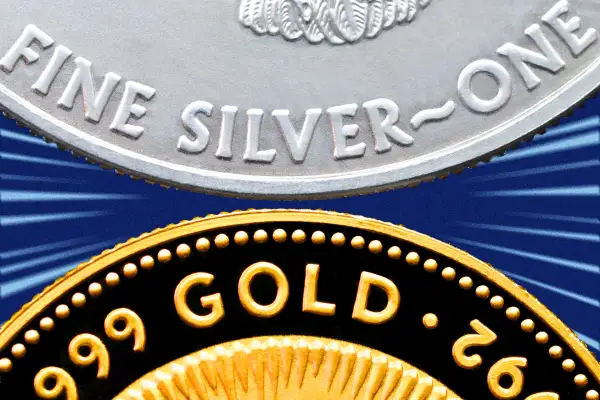


Precious metals have played an integral role in civilizations for thousands of years. Some of these assets have delivered impressive returns for long-term investors, but new investors care more about which investment will deliver higher returns now.
Gold is the more established asset, but in recent years — including stretches in 2024, 2025 and 2026 — silver has at times outperformed the yellow metal over shorter timeframes. Is it a sign of changing times? This analysis will dive into both assets and reveal which one looks more promising going forward.

What causes precious metals to gain value?
Every investment gains value due to fluctuations in supply and demand. Precious metal investments are no different. Gold and silver become more valuable when interest rates go down and inflation increases. That’s because people use fiat currencies — or government-issued paper money — to buy gold and silver.
Lower interest rates and higher inflation reduce the purchasing power of each dollar, which means more dollars are required to obtain the same amount of gold and silver. Precious metals also appreciate during periods of economic and global uncertainty, as they offer silver and gold investors a safe haven from more volatile assets like stocks.
Distinctions for gold
While all precious metals experience price fluctuations for the same reasons, each one has a few key distinctions. Those distinctions result in different returns for each asset within the precious metals category.
For instance, a key distinction with gold is that it is a luxury mineral. Almost half of all the distributed gold goes toward jewelry. During strong economic cycles, more people will buy luxury goods, driving up gold prices in the process. In 2025, jewelry consumption totaled about 1,542 tonnes of gold demand. It’s not only used for luxuries, as central banks and other institutions bought about 863 tonnes in 2025. Technology demand was about 323 tonnes, a much smaller slice than jewelry and investment demand.
Gold will appreciate the most when people view it as a good investment and buy luxury items. Its value as an investment can help it endure economic uncertainties, but less demand from jewelers can put downward pressure on the asset.
Distinctions for silver
Silver is also valued as an investment, with net physical investment totaling about 190.9 million ounces in 2024 (roughly 16% of total demand). This percentage has fluctuated slightly in the recent past, but it demonstrates that people are still accumulating silver as an investment.
However, more notably, about 460.5 million ounces of demand went to electrical & electronics in 2024 (roughly 40% of total demand). This vast category includes semiconductors, consumer electronics, power distribution and other segments.
Between the latest smartphones and the rise of artificial intelligence, demand has been soaring for electronics. Gold also benefits from this growing demand, but silver is in a better position to rally due to tech innovations.
Almost 209 million ounces of silver demand went toward jewelry in 2024 (roughly 18%). The precious metal benefits from the luxury industry’s success, but it’s not as dependent on that industry as gold.
Long-term performance
Although silver has outperformed gold during some stretches from 2024 through 2026, that hasn’t always been the case. Over long horizons, leadership can shift between the two metals, but silver tends to be more volatile — with sharper rallies and deeper drawdowns — while gold is often favored for relative stability and diversification.
Gold’s lead becomes more pronounced with a wider lens — it boasts a 15-year annualized return of 4.9% that dwarfs silver’s annualized 2.7% return over the same period.
Deciding on gold vs. silver
Silver has more catalysts that can drive higher returns for long-term investors. Artificial intelligence and tech products have stimulated the broad electronics industry, which has increased demand for silver. Those industries also have high projected compounded annual growth rates that imply a heightened demand for silver.
According to Precedence Research, the AI industry is expected to grow by a compound annual growth rate of 19.1% from 2024 to 2034, expanding from $638.23 billion to $3.680 trillion over that time frame.That is bullish for silver given its industrial applications.
Both precious metals are used as investments and benefit from jewelry sales. Gold is more lopsided toward those two categories. It’s worked well in the past, but tech presents more compelling growth prospects than the luxury industry.
Gold derives almost all of its value as an asset from investments and the luxury industry’s success. The biggest advantage gold has over silver is its supply. Even though more industries will require silver in the future, there’s less gold available, and scarcity can heighten demand. The total silver supply is roughly 1.0 billion ounces per year, while annual gold mine production was about 3,672 tonnes in 2025 (roughly 118 million ounces). That means there’s roughly more than eight times more silver than gold added to the total supply each year.
Even though gold has supply on its side, silver may still generate higher returns. The gold-silver ratio, a metric that shows how many ounces of silver it takes to buy an ounce of gold, currently shows that it takes roughly 87 ounces of silver to buy an ounce of gold. Historically, this ratio ranges from 50–70 ounces of silver being required to buy an ounce of gold. If this ratio corrects, it gives silver an opportunity to appreciate at a faster rate than gold.
Prudent investors can accumulate either gold and silver in order to benefit from positive momentum from both assets. However, silver has gotten the upper hand in recent years, and that trend is likely to continue in the near- and medium-term.
Stone-hard wealth protection