
You Can Invest in SpaceX Before It Goes Public — if You're Willing to Pay

- Want to Invest in Billionaires' Companies? This New ETF Makes It Easy
- These Tiny Companies Have Doubled the S&P 500's Gain This Year
- This Under-the-Radar Restaurant Stock Is Outperforming Chipotle and McDonald's
- How Elon Musk's SpaceX Could Supercharge the Next IPO Frenzy
- From AI to Energy, 'Thematic' ETFs Make It Easy to Invest in Hot Market Trends

Money is not a client of any investment adviser featured on this page. The information provided on this page is for educational purposes only and is not intended as investment advice. Money does not offer advisory services.
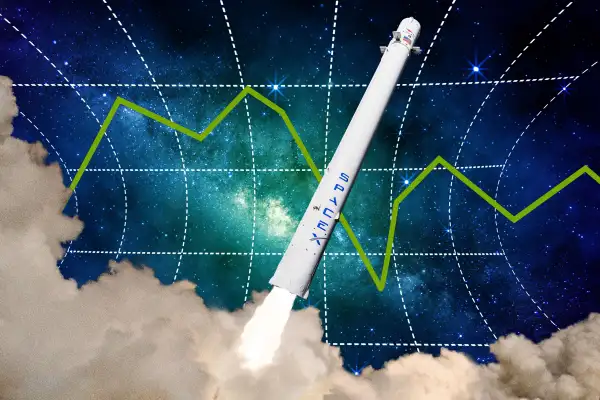
After years of anticipation, in April, Elon Musk confidentially filed an initial public offering (IPO) for SpaceX with the U.S. Securities and Exchange Commission.
The move positions the aerospace and artificial intelligence company, which Musk founded in 2002, to go public as soon as June. It also sets the stage for the world's richest man to become the first CEO at the helm of two publicly traded companies with valuations in excess of $1 trillion.
Access to IPOs is traditionally reserved for institutional investors (like asset management firms, investment banks and hedge funds) and accredited investors (like people with a net worth over $1 million, excluding their primary residence, or annual income over $200,000). But there is a way for everyday investors to gain exposure to SpaceX before its public debut — at a comparatively steep price.
Here's what to know.

SpaceX's IPO could be the largest in history
Combining rocket launch services, a subsidiary Starlink satellite business segment and — following a recent merger with xAI — large language models, SpaceX is seeking to raise between $50 billion and $75 billion through its public offering. That would make the company's IPO the largest in history, supplanting the $25.6 billion raised by Saudi Aramco, the owner and operator of the world's largest oil and gas network, when it went public in 2019.
Additionally, by targeting an IPO valuation of $2 trillion, SpaceX would become the sixth-largest publicly traded company, trailing only Magnificent Seven members Nvidia, Apple, Alphabet, Microsoft and Amazon.
For context, Musk-led Tesla's market capitalization is currently $1.4 trillion.
Part of the appeal to investors is the company's recurring revenue model, which hinges on subscriptions for Starlink's high-speed, low-latency space-based internet. More than 10,000 Starlink satellites are currently in orbit servicing over 10 million customers worldwide.
SpaceX is also a premier government contractor, having secured an estimated $22 billion worth of federal contracts with agencies including NASA and the U.S. Department of Defense.
The company's recent merger with xAI incorporates a $250 billion AI company into the SpaceX fold. As a subsidiary, xAI introduces a stream of revenue that includes Colossus, the world's most powerful AI supercomputer. As part of the merger, SpaceX is now working toward the development of space-based data centers, using solar power-equipped satellites to scale the company's massive AI compute.
How to invest in SpaceX
While the date of SpaceX's official public listing has yet to be announced, retail investors can gain access before its IPO via a niche investment vehicle. However, it comes with notable caveats that not everyone may be comfortable with.
The ARK Venture Fund, or ARKVX, is actively managed by Ark Invest, an investment management firm led by founder and CEO Cathie Wood (who famously invests in companies focusing on disruptive technologies). The fund aims to provide retail investors with access to venture capital-style investments, including SpaceX.
However, unlike straightforward exchange-traded funds that have surged in popularity, the ARK Venture Fund is a closed-end interval fund — a type of SEC-registered investment company that does not trade on exchanges, often invests in alternative assets like private equity and can present illiquidity challenges. Shareholders of interval funds lack the ability to freely sell until periodic repurchase windows open.
In the case of the ARK Venture Fund, those opportunities come quarterly. But a disclosure on Ark's official website warns prospective investors and current shareholders of that illiquidity risk, stating that "You should not expect to be able to sell your Shares other than through the Fund's repurchase policy, regardless of how the Fund performs... Although the Fund will offer to repurchase Shares on a quarterly basis, Shares are not redeemable and there is no guarantee that shareholders will be able to sell all of their tendered Shares during a quarterly repurchase offer."
The disclosure further states that an "investment in the Fund's Shares is not suitable for investors that require liquidity, other than liquidity provided through the Fund's repurchase policy."
Palash S. Islam, CEO of Synergy Financial Group, says this isn't necessarily a red flag. But he cautions investors looking to jump in now.
"Now is way too late. They missed the boat," he writes in an email to Money.
Islam also points to how the "retail wrapper" — using a fund to provide everyday investors with access to pre-IPO companies — removes transparency and flexibility. He adds that investing in the ARK Venture Fund simply to gain exposure to SpaceX prior to its IPO is difficult to justify, noting that "Ark will likely capitalize on the momentum and excitement to drive higher flows into the fund."
More money moving into a fund does not directly translate to higher share prices, but it does translate to additional revenue for fund managers. (Ark Invest did not immediately respond to Money's request for comment on this and other details.)
Another point of consideration is the fund's annual fees, which currently amount to 3.49% and are "meaningfully higher than traditional active management," says Islam.
For context, the average expense ratio for an actively managed ETF falls between 0.5% and 0.75%. Even after a 0.59% expense reimbursement and fee waiver offered by Ark Invest, its Venture Fund's net expense ratio is still 2.90% — 364% higher than the average for actively managed ETFs.
For investors who can look past those conditions, shares are available via platforms like SoFi and Titan with a $500 minimum investment, according to the fund's prospectus. Beyond SpaceX — ARK Venture Fund's top holding, which currently accounts for 13.76% of the total portfolio — it also provides exposure to ChatGPT-maker OpenAI, Anthropic and other tech startups that could eventually see IPOs of their own.
"We have traditionally stayed away from deals like this," Islam says. "But for some clients, if they are looking for [pre-IPO] access, this may be the only way. Hopefully they got in years ago and are not chasing returns today."
It's never too late to start investing

Get up to 1,000 in stock when you open & fund a new Active Invest account7
- Get a 1% Match When you Transfer your Retirement Investments to SoFi IRA1
- Ranks #1 in JD Power 2026 U.S. Investor Satisfaction Study for DIY Investors10
- 1% Match on recurring deposits, paid in rewards points with a SoFi Plus8 membership
- Buy & sell stocks with no commissions2
INVESTMENTS ARE NOT FDIC INSURED • ARE NOT BACK GUARANTEED • MAY LOSE VALUE

Earn an uncapped 1% match when you transfer or rollover a brokerage account, IRA or 401(k)*
- Invest in stocks, bonds, options, crypto and more
- Earn rebates on your options trades, including with our free active trading API
- Turn any idea into an investable index. Just enter a prompt, and put our AI to work
- Invest for retirement with a matching 1% bonus on your annual IRA contributions
- Earn 3.3% APY** on your cash with no fees.

Get Up To $1,500 When You Open and Fund a New Brokerage Account With a Qualifying Deposit¹
- No account minimums or maintenance fees²
- Invest in stocks, etfs, bonds, options and more
- Get investing insights from Morgan Stanley
- Available desktop trading platform with customization options

Some of the lowest margin rates on average than competitors
- $0 commission on stocks and ETFs (Other fees may apply)
- Easily transfer accounts, including deposits, brokerage, and 401Ks
- Buy, sell and store popular cryptocurrencies
*Terms apply. Rate subject to change.

Easy and automated investing, starting at $3 a month
-
Online banking that automatically saves and invests with no hidden fees
-
Earn bonus investments from thousands of top brands
- Expert-led, bite-sized courses to increase your financial knowledge
More from Money:
Is This 2008 All Over Again? Fears of a Financial Crash Grow Among Investors
Private Equity, Crypto and Other Risky Assets Are Coming to Your 401(k). Here's What to Know
You Can't Buy Stock in the Startup Behind ChatGPT. But You're Probably Invested in It Anyway