Why Trump Wants to Keep America's House Prices High

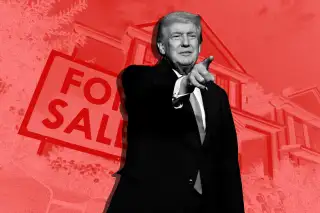
President Donald Trump is keeping the focus on housing affordability this year, but there's one component he's unwilling to touch: high home prices.
Most housing experts agree that one of the main factors that could drive greater affordability is increasing supply. Higher inventory levels tend to result in slower home price growth, which expands homebuying power over time. However, more inventory would also lower home values overall, an outcome Trump seems to find unacceptable.
During a Jan. 29 meeting, Trump told his cabinet that homeowners have become wealthier because their homes are now worth more than ever before, adding that he is reticent to take any action that could affect those gains.
Your future dream home awaits — Unlock your interest rate now
Unlock your interest rate now
Your Information
Not sure which loan type to choose? Go with a 30 Year Fixed Rate Loan, 90%+ of Americans do.
You can enter the mortgage loan amount, or the total home price if you have a downpayment.
Your Estimated Rate
Estimated interest rate*
Money’s Methodology
*Based on the U.S. average rate for consumers with an Exceptional Fico score (780+) getting a conventional loan, no points, and a 20% down payment. Actual rates may vary. Click "View Rates" to contact Mortgage Research Center Mortgage Rates (NMLS #1907) for a more accurate quote.

"I don't want to drive housing prices down. I want to drive housing prices up for people that own their homes," he said. "When you make it too easy and too cheap to buy houses, those values come down."
For others concerned about housing accessibility, however, increasing supply isn't necessarily at odds with preserving home values. Jonathan Treble, a Democratic candidate running in Arizona's first congressional district, says Trump's remarks show how out of touch he is with many Americans struggling to buy homes.
"Adding affordable housing doesn't mean that for homes in other areas, those prices are going to go down," Treble tells Money. "You could do both."
Trump's motivation for keeping prices high is relatively simple. Homeownership has long been considered one of the best ways to accumulate wealth because of year-over-year appreciation, and current homeowners have benefited from the rapid rise in home values during the pandemic years.
According to the National Association of Home Builders, home prices increased by almost 55% nationwide between the beginning of 2020 and the third quarter of 2025, with some cities seeing home values appreciating by as much as 88%.
These higher prices have led to near-record levels of home equity, with the St. Louis Federal Reserve estimating the aggregate value of U.S. homes at over $34 trillion. Individual homeowners who still hold a mortgage have almost $300,000 in equity on average, according to the most recent data from analytics firm Cotality.
There also may be a political reason the president may want home prices to continue rising.
According to the Pew Research Center, older voters tend to vote Republican, while younger voters generally favor Democrats. Americans over 55 also have the highest homeownership rates, per U.S. Census Bureau data.
With midterm elections scheduled for later this year, some political analysts believe Republicans may lose control of the House of Representatives, making it much harder, if not impossible, for Trump to implement his agenda. According to Kevin Leibowitz, president and CEO of Grayton Mortgage, any negative change in home values is likely to be unpopular among homeowners.
"If their home prices go down, and it's viewed as a result of actions or inactions of politicians, the voting base is going to be rankled," Leibowitz says. "That certainly won't help at the time of the elections."
Trump pushes to lower interest rates
Making homeownership more accessible to buyers remains a stated priority for the president. But instead of increasing housing supply, Trump is focused on reducing mortgage rates to improve affordability.
"The best thing that can happen for both groups of people is lower interest rates," Trump said during the cabinet meeting. "Lower interest rates keep the values up for the people that have housing and lets other people buy housing."
The administration has already taken steps to lower rates. In January, Trump instructed his representatives at Fannie Mae and Freddie Mac to buy $200 billion in mortgage bonds, which immediately lowered mortgage rates by about 0.2 percentage points, resulting in the lowest rates in more than a year.
Although current mortgage rates have ticked up slightly since the initial announcement, they remain nearly a full percentage point lower than they were a year ago. A recent report from online brokerage Redfin estimates that the median monthly mortgage payment has decreased by about $125 in that period.
Trump is also exerting pressure on the Federal Reserve to lower the federal funds rate — the interest rate banks charge each other for short-term loans — in order to lower overall borrowing costs. So far, the Fed has resisted.
Even if the central bank were to cut rates, it probably would not lower mortgage rates. Lenders set their rates based on economic conditions and the Fed's view on the overall strength of the economy. If the economy weakens and the central bank signals that a rate reduction is imminent, that could push interest rates lower than the actual cut would.
The White House has also floated other proposals, including introducing 50-year mortgages to lower monthly payments and allowing homebuyers to withdraw money from their 401(k)s to fund a down payment. But both face significant obstacles before they can be implemented.
More from Money:
Housing Market Forecast: Will Home Prices Finally Fall in 2026?
Buying a House? This Overlooked Step Could Save You $1200 a Year