Ticketmaster and Airbnb Are Now Required to Show You Fees Upfront. Are DoorDash and Instacart Next?

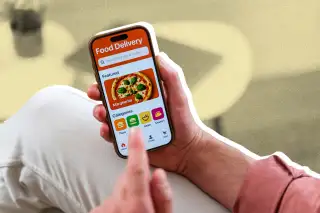
If you've ever added an $18 entree to a delivery app cart — only to realize that it's going to cost $30 to actually get the food to your door — you're familiar with the pesky fees these apps charge at checkout.
But your $30 burrito might not be $30 for long.
Must Read
The Federal Trade Commission, or FTC, has begun the process of creating a potential consumer protection rule cracking down on "unfair and deceptive fee practices" in food and grocery delivery apps. May 18 was the deadline for stakeholders, shoppers and couriers to make their voices heard in a public comment period; hundreds of letters and messages came pouring in.
A central question was: "Should such a rule require online food delivery platforms, in any offer, display, or advertisement that represents the total price of goods or services, to disclose the total price including all mandatory fees and charges more prominently than any other pricing information?"
It sparked enormous debate over the idea of an "all-in" price requirement for food delivery, with billion-dollar companies that are heavily invested in the outcome bringing in lawyers, starting mobilization campaigns and writing letters detailing their arguments.
So who commented? What did they have to say? And what's next? Here's what you need to know.
Will the government ban food delivery fees?
You may recall that a year ago, the federal government forced ticket marketplaces like StubHub and short-term rental platforms like AirBnB — previously notorious for tacking on extra fees at checkout — to show all-in prices upfront.
First proposed as an economy-wide rule in 2023, an early version of the policy would have covered food and delivery apps, but they survived that round of regulation when it was narrowed in 2024. The rule was part of a broader crackdown on what then-President Joe Biden classified as "junk fees" eating into Americans' pocketbooks.
The ticket and hotel junk fee ban, which took effect under President Donald Trump, has largely been welcomed by consumers who today can more easily compare prices between apps to find the best deal. But they continue to wrestle with the cost of food delivery, which a recent analysis found costs nearly 80% more than pick-up.
Food and grocery delivery apps typically charge fees that shoppers only see when they've finished picking out everything they want. At that point, you're hungry, and you're hooked: Whereas you might have resisted paying a high price initially, your resolve has vanished by the time you've reached checkout. Resubmitting the order elsewhere — or, gasp, cooking your own meal — sounds so unappealing that you're willing to pay almost anything.
Though this practice, also called "drip pricing," is unpopular on its face, not everyone agrees that it's deceptive.
In its comment to the FTC, the Flex Association, a lobbying group representing food delivery companies, argued that current rules are adequate, saying that "existing policy frameworks already incentivize transparency." It has a financial motive for not rocking the boat: DoorDash alone reported $11.5 billion in U.S. revenue last year — a figure that includes merchant commissions, customer fees, memberships and other revenue sources.
The Flex Association claimed its members already display fees "as early as possible in the shopping process," saying that it would not be practical to display fees prior to checkout. It also asserted that all-in pricing would blur the line between menu prices and the fees for third-party delivery, which "are distinct and should be considered separately."
TechNet, an organization representing tech CEOs, laid out a hypothetical involving bananas in an attempt to illustrate the industry's concerns.
In its example, we're told to imagine a low-price item: a bunch of bananas. The bananas are $2 and subject to a $4.99 delivery fee. All-in pricing would require the app to display a $6.99 price for those bananas, which could lead to unnecessary sticker shock.
And whereas food delivery fees are often based on distance, delivery speed and other factors, it claimed ticket fees are more standardized.
"As the customer adds or removes items, the displayed item price would shift with each change, because the per-item share of the delivery fee changes with basket size," TechNet said in its comment. "This is fundamentally different from a concert ticket, where the price and fees are fixed from the start."
However, consumer advocates dispute that any of this is as complicated as industry groups are making it sound. States like California and Minnesota have already enacted regulations banning certain junk fees, including in the context of third-party food delivery, though the laws are more limited than what the FTC appeared to reference.
"In California, when food delivery platforms advertise a price for a delivery service, it must be the full, all-in price of the delivery service," California Attorney General Rob Bonta wrote in a news release, sharing its comment in support of new federal rulemaking.
But in practice, Uber Eats, DoorDash and Grubhub do not currently use true all-in pricing in California: They have interpreted the law to simply mean that when they display a delivery fee, they show all required fees, including service charges.
That leaves a lot of room to tack on charges that raise order totals well above the menu prices shoppers see when scrolling.
For example, prices for medium Jamba Juice smoothies are listed between $14 and $16 on delivery app menus, but that is only a subtotal. Once the smoothie is in a shopper's Grubhub cart, the next screen shows a price of $23.19, which includes a delivery fee, "other fees" and tax. On the final checkout page, the price rises to $25.19, with a default tip of $2 applied, though that can be unselected. (The shopper also has an option to pay another $2.99 for priority delivery.)
Grubhub has argued that its fees are more transparent than its competitors' fees. In a last-minute comment, CEO Howard Migdal offered a possible path forward for FTC regulation, somewhat breaking with the Flex Association.
In 2014, Grubhub was fined $25 million for junk fee violations. As a result, Migdal explained, the company was required to work with the FTC on various fee-display reforms. For example, Grubhub no longer advertises $0 delivery on its home or search pages in situations when there are service fees coming later.
Migdal proposed that a forthcoming FTC rule ought to extend this requirement to its competitors.
"The FTC does not need to use the rulemaking process to invent an entirely new standard but instead should examine the requirements it has imposed on Grubhub to ensure that all market participants in the food delivery space adhere to consistent, fair, and known criteria," he said.
Discounts Galore with an AARP Membership
Where the heavy hitters agreed — and diverged
The comment period also drew notable submissions from organizations representing grocery stores and restaurants: two of the most important stakeholders in this process.
The National Grocers Association, which represents independent grocers, argued that FTC "intervention is warranted" while calling for rules to be "written and enforced so all participants compete on equal terms."
As it stands, consumers have "little insight into whether product prices are marked up or what services are tied to add-on fees. They cannot effectively comparison shop because these platforms often lack price transparency and predictability," its letter read.
The Independent Restaurant Coalition appeared similarly worried about hidden fees, which it said often lead to merchants taking blame from consumers for high prices that are outside of a restaurant's control. The association "strongly supports" FTC rulemaking and argued consumers must be informed that delivery app commissions are the reasons for higher prices.
"A regulator or consumer who sees a higher price on a delivery app and attributes it to restaurant pricing decisions has been misled by a system the platform designed," the letter said.
Uber attempted to shed itself of responsibility for markups from in-store pricing. In its comment, the company said merchants have discretion to set higher prices in apps than in stores, while calling a mandate requiring the labeling of these markups "unworkable" because Uber "does not have real-time visibility into all in-store pricing information."
The Independent Restaurant Coalition would dispute this characterization. The company noted that independent restaurants "typically operate on net profit margins of 3–5%," while delivery apps charge their members "commissions of 15–30% of total order value."
That leaves restaurants two choices: raise delivery prices or opt out of Uber Eats entirely.
The groups asking for carveouts
The National Retail Federation — which represents some of the nation's largest companies, including Walmart, Target and Amazon — wrote in mostly to ask that whatever rules get approved for third-party food delivery are not applied to them.
"A broader rule sweeping in retailers, [direct-to-consumer] businesses, and subscription services… would restrict practices that do not deceive or harm consumers, drive up costs, disadvantage small businesses, and stifle delivery innovations that consumers value," the federation's letter read.
Similarly, the International Franchise Association, on behalf of the fast food industry, called for no new rulemaking with respect to its members' in-house delivery. If all-in pricing moves forward, it should only apply to third-party delivery companies, the association wrote.
The National Restaurant Association also requested a carveout for restaurants' first-party delivery.
Where People Are Earning With High-Yield Savings Accounts
DoorDash has yet to comment
DoorDash, the market leader in food delivery, did not appear to submit a comment of its own.
However, browsing the 200-plus FTC comments, it appears that there may have been mobilization efforts to drive comments from certain groups of shoppers and delivery people. For example, at least nine commenters wrote in using an identical format, starting with "As a Dasher, I am concerned that…"
Most of these comments referenced concerns about "downstream impacts" that could affect their livelihoods if regulations go through. Several self-identified couriers praised the "flexibility" that DoorDash gives them in their work lives.
Similarly, at least 11 Instacart customers wrote in with the format "My name is…" and shared generally positive comments about their experience with Instacart. For example, Leslie Kent said in a brief message that "Instacart has bought and hand delivered all of my grocery and cat needs for nearly four years," which makes her life easier because she is "housebound without a car" and her local bus system is slow.
While many of these comments did not weigh in on the regulation besides praising the company, several did. For example, Douglas Herman wrote: "Leave Instacart alone beside don't you people have other things to do."
Instacart, the largest third-party grocery delivery app in the U.S., did comment, requesting no new rule or a "narrowly-tailored" rule. The company argued that "the all-in pricing model would translate into a government-imposed mandate to show confusingly high prices for individual goods that do not reflect final costs."
The strangest part of this story
The FTC hasn't tipped its hand about where this debate is headed, adding intrigue to the process.
The ticket and hotel rule was proposed about a year after the advance notice of rulemaking, with the final rule being released another year after that. All told, it took about 2 1/2 years for the policy to take effect, hinting at a possible timeline for a delivery fee rule. (The FTC did not respond to Money's request for comment on next steps.)
Amid all of this, there are politics at play behind the scenes.
Despite the great lengths organizations have gone to weigh in on all-in pricing in food delivery, several factors make it hard to imagine such a rule actually taking effect under the Trump administration. In addition to being an outspoken business advocate, Trump has dismantled large parts of the Consumer Financial Protection Bureau and rolled back consumer protections such as a Biden-era cap on overdraft fees.
Applying a hotel/ticket-style rule to food delivery would be even more aggressive than what California, a famously liberal state, has done. And while many Americans have praised the shift to all-in pricing in concert tickets, that junk fee rule originated from the Biden FTC. It's a highly progressive policy that consumer advocates demanded.
If that's not enough to make you skeptical, Andrew Ferguson, who is now the chairman of the FTC, was an FTC commissioner in December 2024 when the policy banning junk ticket and hotel fees was approved. He objected to that rule "on the ground that the time for rulemaking by the Biden-Harris FTC is over."
In the 4 to 1 vote, Ferguson was the lone dissenter.